
Table of Contents
- Why Time Saving Kitchen Gadgets Actually Matter in 2026
- Quick Comparison: Best Time Saving Kitchen Gadgets 2026
- Essential Kitchen Gadgets for Meal Prep That Cut Hours Off Your Week
- Best Smart Kitchen Appliances 2026: What's Worth the Bench Space
- Time Saving Cooking Hacks for Busy Families (Backed by the Right Gear)
- Ergonomic and Accessible Gadgets: Kitchen Tools for Every Hand
- Sustainability, Repairability and Smart Home Integration
- Conclusion: Choosing Your Time Saving Kitchen Gadgets
- Frequently Asked Questions
Last Updated: September 20, 2026
Why Time Saving Kitchen Gadgets Actually Matter in 2026
The average home cook spends more time on prep and cleanup than on actual cooking. That's the real reason best time saving kitchen gadgets 2026 have moved from novelty to necessity. This guide from Oddities & Ends breaks down what's worth buying, what's overhyped, and how to build a kitchen that works faster without cluttering your benches.
Time saving kitchen gadgets are tools designed to reduce manual effort in food prep, cooking, or cleanup.
Quick Comparison: Best Time Saving Kitchen Gadgets 2026
Here's how the top categories stack up on effort saved, cost, and who they suit best.
| Gadget Category | Time Saved | Best For | Maintenance |
|---|---|---|---|
| Food processor | High (chopping, mixing) | Batch cooking, meal prep | Dishwasher safe parts |
| Air fryer | Medium (faster cooking) | Quick weeknight meals | Wipe-down basket |
| Sous vide | Medium (hands-off cooking) | Precision cooking | Minimal |
| Garlic press | Low but daily | Everyday cooking | Rinse immediately |
| Vegetable dicer | High (uniform cuts) | Meal prep, salads | Hand wash |
| Smart storage containers | Indirect (less waste) | Kitchen organisation | Dishwasher safe |
Essential Kitchen Gadgets for Meal Prep That Cut Hours Off Your Week
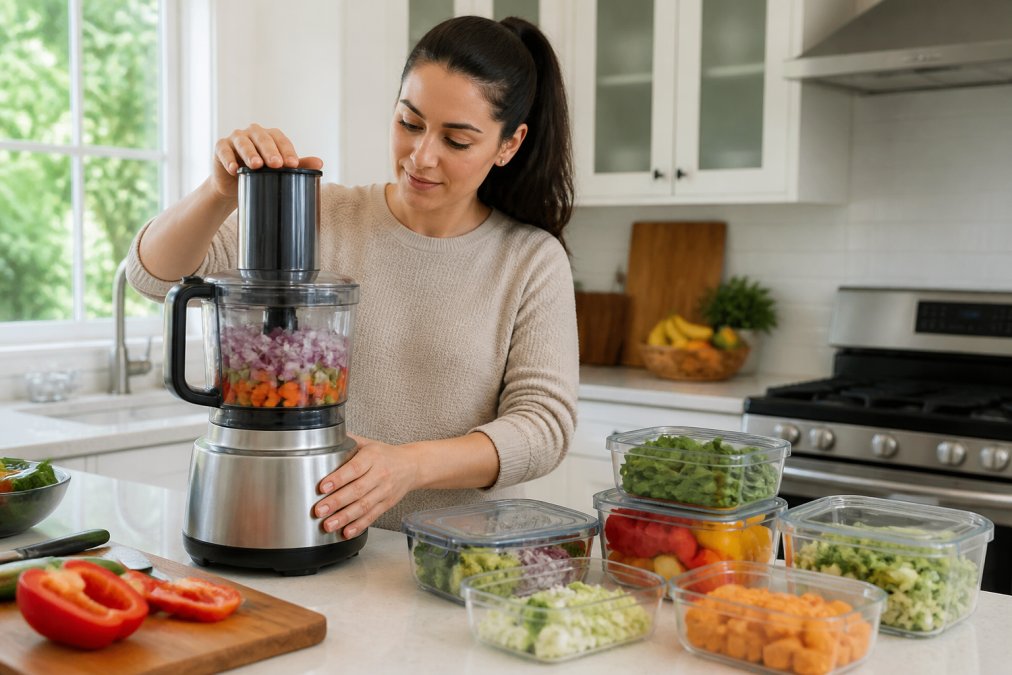
For meal prep specifically, look for dishwasher safe parts and durable materials. Cheap plastic dicers crack within months. Stainless steel blades and BPA-free containers last years.
Best Smart Kitchen Appliances 2026: What's Worth the Bench Space
Smart kitchen appliances are worth it only if they replace a task you already do, not if they add a new one. An air fryer earns its space. A connected scale you use twice a year does not.
What actually makes a countertop appliance 'smart'
Strip away the marketing and there are only three mechanisms that matter:
- Closed-loop temperature control. A sous vide circulator holds water within a fraction of a degree for hours. That's why it can cook a steak hands-off while you do something else, the appliance, not you, is managing the variable.
- Preset programmes with a keep-warm phase. A programmable slow cooker that switches to 'warm' after the cook time is the single feature that stops dinner from becoming a decision at 7pm.
- App or voice triggers tied to a real workflow. Useful when they let you start a pre-loaded appliance remotely or queue a cook around your commute. Useless when they simply mirror buttons already on the front panel.
The bench-space maths
A standard 600mm benchtop has roughly 0.18 square metres of usable depth once you allow for a splashback and a chopping board. Every appliance you leave out permanently claims part of that. The test isn't 'is this smart?', it's 'how many other tools does this replace, and how often?'
| Appliance | Replaces | Typical footprint | Realistic weekly use |
|---|---|---|---|
| Air fryer (5-6L) | Oven for small batches, toaster, sometimes a fryer | ~0.06 m² | 4-6 cooks |
| Sous vide circulator | Precision oven, thermometer, guesswork | ~0.02 m² (stored) | 1-2 cooks |
| Programmable slow cooker | Stockpot, oven on low, attention | ~0.05 m² | 2-3 cooks |
| Multi-cooker (pressure + slow + sauté) | Rice cooker, slow cooker, pressure cooker, one saucepan | ~0.07 m² | 3-5 cooks |
Voice assistants and app integration: what's genuinely useful
If you already run a voice assistant in the kitchen, the integrations worth having are the ones that remove a physical step: preheating an oven or air fryer before you walk in, starting a slow cooker from the car, or asking for a remaining cook time without opening a door. Everything else is novelty.
Time Saving Cooking Hacks for Busy Families (Backed by the Right Gear)
Time saving cooking hacks for busy families come down to two things: fewer decisions and fewer dishes. The right gear supports both.
- Cook once, eat twice: Double every recipe and refrigerate half for tomorrow.
- Use one pan where possible: Sheet-pan dinners cut cleanup in half.
- Pre-chop on weekends: Store in reusable containers for the week ahead.
- Embrace the air fryer for weeknights: Faster than the oven, easier than the stove.
- Keep an oil dispenser within reach: Small tool, constant use.
Ergonomic and Accessible Gadgets: Kitchen Tools for Every Hand
Ergonomic design isn't a luxury feature. For anyone with arthritis, reduced grip strength, or limited mobility, it's the difference between cooking and ordering takeaway.
Sustainability, Repairability and Smart Home Integration
Most 'best kitchen gadget' lists stop at the checkout. This section is the one they skip: what happens to the gadget in year three, year five, and at end of life. That's where the real time and money savings live, a tool you replace every 18 months costs you the purchase price plus the shopping time, every time.
Materials: what to look for and why
- Stainless steel (blades, bodies, bowls). Doesn't absorb odours, won't stain from turmeric or tomato, and can be sharpened or replaced rather than binned. A stainless blade outlasts a coated one by a wide margin in normal home use.
- Borosilicate glass (storage, jugs). Doesn't retain smells, tolerates thermal shock, and is fully recyclable at end of life. Heavier than plastic, but it doesn't cloud or crack the way cheap polypropylene does.
- Silicone (spatulas, lids, baking mats). Food-grade silicone is heat-stable and long-lived. The catch is end-of-life: most kerbside recycling doesn't accept it, so buy fewer, better silicone items rather than a drawer full.
- Bamboo and FSC-certified wood (boards, utensils). Fast-growing and renewable, but they need oiling and they can't go in the dishwasher. A bamboo board that warps in three months isn't sustainable, it's disposable with extra steps.
- Recycled steel and recycled-content plastics. Worth preferring where the function is identical, but treat 'recycled' as a tiebreaker, not a reason to buy.
Repairability: the five questions to ask before you buy
- Are spare parts listed? If the manufacturer sells replacement blades, gaskets, seals or bowls, the appliance has a service life. If not, it has an expiry date.
- Is the motor serviceable? A food processor with a replaceable blade set and an accessible motor will outlast three sealed units. Ask whether the motor can be replaced at all.
- Are fasteners standard? Screws you can undo with a normal driver beat tamper-proof or glued housings.
- Is the battery user-replaceable? For cordless tools, hand mixers, milk frothers, electric openers, a sealed battery is the single most common failure point and the hardest to fix.
- Is there an Australian warranty and a local service path? Under the Australian Consumer Law, goods must be of acceptable quality and fit for purpose, and remedies can extend beyond the stated warranty period depending on the price and expected life of the item. Keep your receipt.
Longevity beats novelty
A cast-iron pan, a good chef's knife, a stainless bowl set and a solid chopping board will outlast a decade of gadget trends. The time-saving argument for buying well is simple: every replacement is a shopping trip, a learning curve and a new failure point. Buying once is the fastest option.
Smart home integration: the honest verdict
Smart home integration is the newest angle in kitchen gear, and the least essential for most kitchens. Connecting a sous vide to your phone is convenient. It won't make you cook more often. Buy for the core function first, the connectivity second, and check that the appliance still works if the manufacturer's cloud service is retired, because that has happened to enough product categories now that it's a reasonable question to ask.
Conclusion: Choosing Your Time Saving Kitchen Gadgets
The challenge isn't finding gadgets. It's finding the handful that actually earn their place on your bench. Start with one multi-functional workhorse, add tools that match how you already cook, and skip anything that adds a new chore.
Frequently Asked Questions
What are the most useful time saving kitchen gadgets for busy professionals?
For busy professionals, the highest-value time saving kitchen gadgets are multi-functional countertop appliances that replace several tools at once. An air fryer, a food processor and a sous vide stick cover most weeknight cooking. Add a garlic press, a vegetable dicer and a set of reusable storage containers for batch cooking. Together these cut prep time significantly and make meal prep realistic even on a tight schedule.
Are smart kitchen appliances worth the investment for meal prep?
Smart kitchen appliances are worth it if you'll use their automation features regularly. A smart air fryer with app-controlled presets or a sous vide cooker that holds temperature precisely removes the guesswork from cooking, which saves time and reduces waste. If you only cook basic meals, a simpler multi-functional appliance may suit you better. Match the smart features to how you actually cook.
How do I choose durable kitchen gadgets that last?
Look for stainless steel blades, die-cast metal bodies and dishwasher-safe parts, and check whether replacement components are sold separately. Repairability matters more than a flashy feature list. Gadgets with a workhorse reputation and spare parts available tend to outlast cheaper alternatives, making them a better investment piece for a busy kitchen.
What are the best space-saving kitchen tools for small kitchens?
For small kitchens, prioritise multi-functional gadgets that stack, collapse or mount. A vegetable dicer with a compact base, a collapsible chopping board and a wall-mounted oil dispenser save bench and cupboard space. Choose appliances with a small footprint but enough capacity for batch cooking, so one device does the work of three.