
Table of Contents
- Start With a 20-Minute Declutter, Not a Shopping Spree
- Small Kitchen Cabinet Organisers That Earn Their Space
- How to Organise Kitchen Cupboards So You Stop Re-Buying What You Own
- Vertical Storage Ideas for Small Kitchens That Use Wall Space Properly
- Renter-Friendly Kitchen Storage With No Drilling Required
- Countertop Space, Under-Sink Storage and the Kitchen Workflow
- Ergonomics, Lighting and Inventory Management in a Tiny Kitchen
- Conclusion: Keep the System Simple Enough to Maintain
- Frequently Asked Questions
Last Updated: October 9, 2026
Start With a 20-Minute Declutter, Not a Shopping Spree
Most people try to organise a small apartment kitchen by buying containers first. That is backwards: no amount of clever storage will fix a cupboard packed with things you never use.
Learning how to organize small apartment kitchen spaces starts with subtraction, not addition.
Set a timer for 20 minutes. Empty one cupboard at a time onto the bench. You will almost certainly find duplicates, expired packets, and gadgets you have not touched since you moved in.
The Four-Box Method for a Small Apartment Kitchen
The four-box method sorts every item into one of four categories: keep, relocate, donate, and bin. It works well in tight kitchens because it forces a decision on every object in one pass.
- Keep: items you used in the last month
- Relocate: things that belong in another room
- Donate: duplicates, unwanted gifts, working appliances you never use
Small Kitchen Cabinet Organisers That Earn Their Space
Storage products only help when they solve a specific problem. A shelf riser that doubles your plate stacking is worth it. A novelty egg holder that eats a whole shelf is not.
The test is simple: does the organiser create usable space, or just move the mess around? Before buying anything, measure three things for every cupboard:
- Internal width, the gap between the side walls, not the door opening
- Internal depth, from the back wall to the inside of the door
- Clear height between shelves, the usable gap once the shelf above is in place
A divider that does not fit wastes money and shelf space at once, and a riser 2 cm too tall will not slide under the shelf above. Measure twice, buy once.
Drawer Dividers, Shelf Risers and Tiered Shelves
Three organisers do most of the heavy lifting in a small kitchen:
- Drawer dividers stop cutlery and utensils from sliding into a jumble. Expandable dividers suit drawers roughly 30-55 cm wide; spring-loaded or adhesive versions work in drawers with thin sides that cannot take a screw.
- Shelf risers create a second layer for plates, tins, and mugs. A riser around 15-20 cm high typically clears a standard 30 cm shelf gap, letting you stack two rows without hitting the shelf above.
- Tiered shelves let you see jars and cans at a glance instead of digging. A three-tier step shelf uses the same footprint as one row but exposes every label, suiting spice jars and small cans better than bulky items.
Materials and Weight Limits That Matter in a Rental
Material choice affects how long an organiser lasts and how much weight it holds:
- Bamboo and acacia are sturdy and wipe clean, but swell in a damp under-sink cupboard. Keep them on dry shelves.
- Powder-coated steel handles heavier loads, tins, cast-iron pans, stacked plates, and resists rust better than bare wire.
- Clear acrylic or BPA-free plastic is the lightest and cheapest option and lets you see contents through the sides. It flexes under heavy loads, so keep it for spices, cutlery, and packets rather than pans.
Check the stated weight rating before loading a shelf riser with cast iron: a riser rated for 5 kg holds dinner plates fine but sags under a full set of saucepans.
Renter-Friendly Fixings
Since most leases forbid drilling, choose organisers that stay put without screws:
- Adhesive strips work for lightweight dividers and small bins, but the surface must be clean and dry first.
- Tension-fit dividers grip the drawer sides and leave no residue when removed.
- Freestanding risers and tiered shelves need no fixing at all, which makes them the safest choice for a rental.
Before you commit, load the organiser with the items it will actually hold, then open and close the drawer or door a few times. If anything shifts, slides, or catches, the fit is wrong.
How to Organise Kitchen Cupboards So You Stop Re-Buying What You Own
If you have ever bought a third bottle of soy sauce because you could not find the first two, the problem is visibility, not space. Learning how to organise kitchen cupboards properly means seeing everything the moment you open the door.
Group similar items together: all baking goods in one spot, all tins in another. Then arrange each group so the oldest items sit at the front.
Deep Cabinets, Corner Cabinets and the Items That Go Missing
Deep cabinets and corner cupboards swallow items whole. Treat the back zone as long-term storage and the front zone as daily use.
- Put rarely used appliances at the back
- Keep daily items within arm's reach at the front
- Use a turntable in corner cupboards so nothing gets stranded
Vertical Storage Ideas for Small Kitchens That Use Wall Space Properly
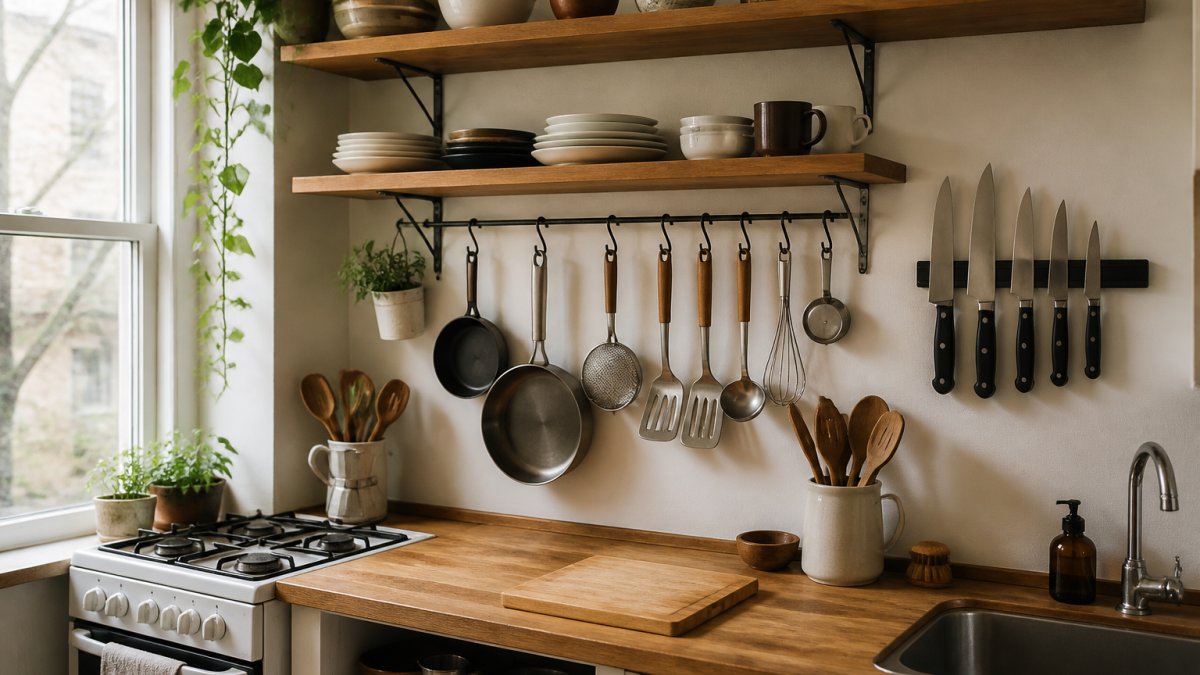
Wall space is the most underused asset in a small apartment kitchen. When bench and cupboard space runs out, the walls are still empty.
Hanging Rails, Magnetic Strips and Over-the-Door Storage
Three wall-based options suit almost any rental:
- Hanging rails hold utensils, mugs, and small pans within easy reach
- Magnetic strips keep knives off the bench and off your fingers
- Over-the-door storage adds a full shelf to a cupboard door for wraps, foil, and lids
Renter-Friendly Kitchen Storage With No Drilling Required
Renter-friendly kitchen storage is any system that adds capacity without damaging the walls. Since most leases forbid drilling, the answer is tension rods, adhesive hooks, and freestanding racks.
Tension rods fit inside cupboards to create extra hanging space for spray bottles and cleaning cloths. Adhesive hooks hold light items on splashbacks and inside doors.
- Tension rods: under the sink, inside cupboards
- Adhesive hooks: splashbacks, inside doors, side of the fridge
- Freestanding racks: gaps beside appliances
Check the weight rating on any adhesive product before you trust it with glass or heavy tools.
Countertop Space, Under-Sink Storage and the Kitchen Workflow
Countertop space is for working, not storing. Every appliance parked on the bench is a square of prep area lost, so move anything you use less than weekly into a cupboard.
Under-sink storage is the exception worth planning carefully. The pipes take up the middle, so use stackable bins on either side and a low tray at the front for sponges and cloths.
What Actually Belongs on the Benchtop
A short list belongs on the bench:
- The appliance you use daily, such as the kettle
- A knife block or magnetic strip within reach
- One small tray for oil, salt, and pepper
Everything else can live in a cupboard, the difference between a kitchen that works and one that just looks tidy.
| Zone | What Goes There | What to Avoid |
|---|---|---|
| Benchtop | Daily kettle, one utensil holder | Appliances used less than weekly |
| Under-sink | Stackable bins, cleaning cloths | Loose bottles that topple |
| Deep cupboard | Rarely used appliances at the back | Daily items buried behind |
| Wall space | Hanging rail, magnetic strip | Heavy items above shoulder height |
Ergonomics, Lighting and Inventory Management in a Tiny Kitchen
Two things separate a kitchen that works from one that just looks organised: how it feels to use, and whether you know what you own. Most guides skip both, focusing on storage products instead of workflow.
Ergonomics in a Tiny Kitchen: The Work Triangle
The work triangle is the distance between your three main work zones, the sink, the cooktop, and the fridge.
A practical rule: keep the three points within about two steps of each other, and keep obstacles, a bin, a trolley, an open dishwasher door, off every leg of the triangle.
Height matters as much as distance. Store the items you reach for most between hip and shoulder height:
- Waist to shoulder: daily plates, mugs, cooking utensils, the frying pan you use every night
- Hip to waist: heavier items, saucepans, the slow cooker, bulk dry goods
- Below hip: rarely used appliances, large stockpots, cleaning supplies
Bending to a low cupboard for the frying pan every night adds up: the items you touch most should never require a squat or a stretch.
Lighting and Visual Expansion
Lighting does more for a small kitchen than any storage product. A single warm overhead bulb leaves the back of the bench in shadow, exactly where clutter hides and where you end up prepping.
Three changes make the biggest difference:
- Under-cabinet strip lights brighten the bench and splashback, so the work surface reads as larger and safer. LED strips that plug into a standard power point avoid any wiring work.
- Cool white light (around 4000K) makes a small kitchen feel brighter and cleaner than warm white, which tends to shrink a space visually.
- Clear containers and open shelving let light pass through instead of being blocked by solid doors. Decanting dry goods into clear jars also makes the pantry look bigger and shows what is running low.
A mirror or glossy splashback can bounce light into a dark corner, but keep it practical, a reflective surface behind the cooktop is harder to clean than a matte one.
Inventory Management for Small Spaces
Inventory management is the habit that keeps the system working. In a small kitchen, you cannot afford to buy what you already own or let food expire at the back of a shelf.
A simple system that works:
- Keep a running list of what is in the pantry, on your phone or taped inside a cupboard door. Update it when you use the last of something, not when you shop.
- Shop for the kitchen you have, not the one you wish you had. Bulk buying only saves money if you have somewhere to store it; in a small kitchen, smaller, more frequent shops often beat a monthly bulk run because nothing gets buried.
- Use the first-in, first-out rule. When new groceries come home, move older items to the front and put the new ones behind them. This stops the duplicate buying and expired food that fills small kitchens.
Putting the Three Together
Ergonomics, lighting, and inventory are not separate projects. A kitchen organised around the work triangle, lit so you can see what you have, and tracked with a simple list stays functional without constant effort. Storage products are the last step, not the first.
Conclusion: Keep the System Simple Enough to Maintain
A system you cannot keep up with is worse than no system at all.
That is where Oddities & Ends can help. We curate practical home organisation finds, from drawer dividers to stackable bins, with free delivery across Australia. If a product arrives damaged or wrong, our team sorts it without the runaround.
Shop now at Oddities & Ends and give your small apartment kitchen the storage it has been missing.
Frequently Asked Questions
How do you organise a small apartment kitchen with limited cupboard space?
Work from the inside out. Empty one cupboard at a time, group items by how often you use them, and move the daily items to the easiest-to-reach shelf. Add small kitchen cabinet organisers such as tiered shelves and drawer dividers so each zone holds one category. Anything used less than once a month goes up high or into a storage box. This keeps a small apartment kitchen functional without buying more furniture.
What are the best cabinet organisers for a small kitchen?
The ones that match your actual cupboard dimensions. Tiered shelves work in deep cabinets because they lift back-row items into view. Drawer dividers stop utensils and cutlery sliding into one pile. Stackable bins suit pantry organisation, and shelf risers double the usable height of a single shelf. Measure your cupboard depth and shelf gap in centimetres before buying, because a riser that is 2cm too tall simply will not fit.
How can renters add kitchen storage without drilling?
Renter-friendly kitchen storage relies on tension, adhesive and over-door fittings rather than screws. Tension rods fit inside cupboards to create extra hanging rails, over-the-door racks add pantry space, and adhesive hooks hold light items on splashbacks. Check your lease and the weight limits on each product before loading it up. Removable adhesive strips are the safest option because they lift off without damaging paint or tiles at the end of a tenancy.
What should you keep on the kitchen benchtop?
Only what you use most days. A kettle, a coffee setup and one or two cooking tools earn their place; everything else creates visual clutter and steals prep space. Aim to leave at least half the bench clear so you have room to chop. If you are short on countertop space, move the toaster or air fryer into a cupboard and bring it out when needed.