
Last Updated: November 2, 2026
Quick Summary
To avoid online shopping scams, check the seller's business name, ABN, address, reviews and contact details before you pay, and always pay by credit card or PayPal rather than bank transfer, gift cards or cryptocurrency. If you are scammed, call your bank first, then report it to Scamwatch.
- A padlock and HTTPS only prove the connection is encrypted, not that the seller is honest.
- A short seller history with a sudden burst of five-star reviews deserves a second look.
- Bank transfers, gift cards and cryptocurrency offer no dispute mechanism once money leaves.
- If scammed, call your bank first, change passwords and turn on two-factor authentication.
- Report the scam to Scamwatch and the platform, and keep screenshots of the listing and messages.
Table of Contents
- Why Online Shopping Scams Are Getting Harder to Spot
- How to Spot a Fake Online Store Before You Pay
- Safe Payment Methods for Online Shopping
- Social Media Shopping Scams: What to Watch For
- Marketplace and Delivery Scams That Catch People Out
- What to Do If Scammed Online Shopping
- Your Pre-Checkout Checklist for Safer Shopping
- Shop Oddities & Ends With Confidence
- Frequently Asked Questions
Why Online Shopping Scams Are Getting Harder to Spot
Scam sites now copy real storefronts almost perfectly. That is the core problem with tips for avoiding online shopping scams in 2026: the old tells have stopped working.
A fake retailer can lift real product photos, real reviews and a polished layout in an afternoon. The Scamwatch guidance from the ACCC makes the same point: anyone can set up an online store, and a professional-looking site proves nothing on its own.
This guide covers the checks that actually work, the payment methods that protect you, and what to do if money has already left your account.
Most guides stop at "look for the padlock". That advice is years out of date.
How to Spot a Fake Online Store Before You Pay
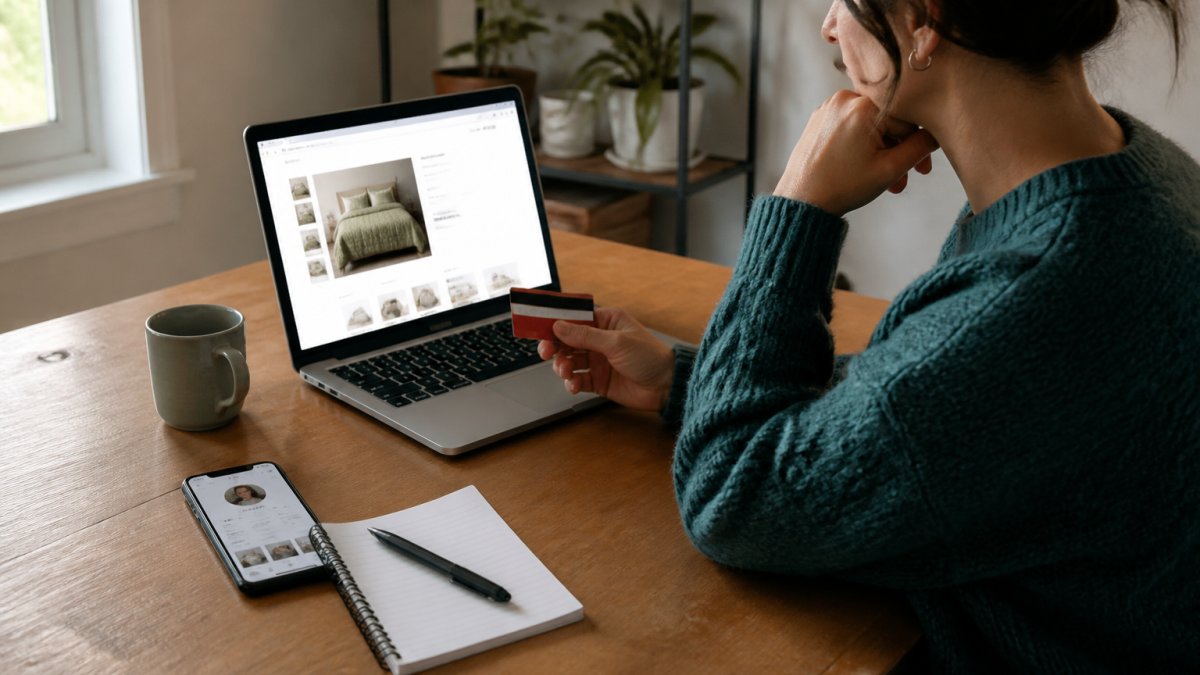
Spotting a fake online store comes down to four checks: the seller's identity, their trading history, their reviews and their contact details. Do all four before you pay, not after.
Check the Website and Seller Profile
Start with who you are actually buying from.
- Look for a full business name, an ABN and a physical address.
- Check the contact page has a phone number and email, not just a form.
- Search the business name separately. Do other sites mention it? Learning how to shop local and support Australian retailers can help you identify genuine local sellers instead of scam storefronts.
That padlock only means the secure connection is encrypted, not that the seller is honest. Scammers buy certificates too.
Read Customer Reviews and Seller Feedback
Reviews are the easiest thing to fake, so read them properly.
On marketplaces, open the seller profile and check seller feedback over time, not just the star rating. A short history with a sudden burst of five-star reviews is worth a second look.
On standalone stores, watch for these patterns:
- Every review is five stars and posted in the same week
- Reviews are generic ("great product, fast shipping") with no detail
- There are no reviews below four stars at all
Also check whether the return policy is easy to find. For judging product and seller quality, read how to find quality home goods: a practical guide.
Safe Payment Methods for Online Shopping
Safe payment methods for online shopping are the ones that give you a paper trail and a dispute process.
Here is how the main options compare:
| Payment method | Protection level | Can you get money back? | How recovery works | Best for |
|---|---|---|---|---|
| Credit card | High | Yes, via chargeback | You raise a dispute with your card issuer; the scheme rules put the burden on the merchant to prove the transaction was legitimate | Most online purchases |
| Debit card | Medium | Sometimes, via your bank | Same chargeback scheme in principle, but the money has already left your account, so you are chasing a refund rather than reversing a debt | Smaller purchases |
| PayPal | High | Yes, via dispute process | Open a dispute in the Resolution Centre, then escalate to a claim if the seller does not respond; PayPal mediates and can refund from the seller's funds | Marketplace buys |
| Bank transfer | None | Rarely | Once the funds land, your bank cannot simply reverse them; recovery depends on the receiving bank's cooperation and is slow and uncertain | Only sellers you know |
| Gift cards | None | No | The value is treated like cash; there is no dispute mechanism and no issuer obligation to refund | Never for strangers |
| Cryptocurrency | None | No | Transactions are irreversible by design; there is no central party to dispute with | Never for strangers |
A credit card gives you the strongest payment protection. If goods never arrive, you can raise a dispute with your card provider.
Bank account details sent by transfer are the scammer's favourite. Once that money moves, it is usually gone.
Gift cards and cryptocurrency deserve a separate warning because they are the two methods scammers ask for when they want to make recovery impossible. No card scheme, no platform and no bank stands behind them. If a seller asks for either, treat it as a stop signal, not a preference.
The Moneysmart guidance on online shopping safety puts it plainly: never send money or give card details to someone you have not met and do not trust.
Social Media Shopping Scams: What to Watch For
Social media shopping scams arrive through your feed, not your search bar. They are built to feel personal and urgent.
The pattern is consistent:
- An ad or post shows a product at an unusually low price.
- A countdown timer or "only 3 left" message creates pressure.
- The link goes to a store you have never heard of.
- Payment is requested by transfer or a suspicious link.
Fake accounts drive most of this. A profile with few posts, a recent creation date and stolen photos is a red flag.
Also be wary of messages from "friends" recommending a sale. Accounts get cloned.
A useful rule: if an offer makes you feel rushed, that is the scam working. Pause before paying. Legitimate retailers do not need to panic you into a purchase.
Marketplace and Delivery Scams That Catch People Out
Marketplace and delivery scams target the gap between paying and receiving. They work because you are already invested.
Common versions include:
- Fake tracking links sent by text or email, asking you to "confirm delivery details"
- Messages claiming a parcel is held and needs a small fee to release
- Sellers who ask you to move the deal off-platform to a private chat
Never enter personal information or passwords through a link in a message. Go to the courier's site yourself and track from there. For practical guidance on avoiding shipping delays and knowing what to expect, see how can you avoid shipping delays in Australia.
What to Do If Scammed Online Shopping
If you have been scammed while online shopping, act fast: contact your bank or card provider first, then report it, then secure your accounts. The order and the evidence you keep in the first hour often decide whether you recover anything.
First hour: stop the money and lock the doors
- Call your bank or card provider and ask to dispute the transaction or stop the payment. Use the number on the back of your card or in your banking app, not a number from the suspect site or an email. Say clearly that you believe it was a scam and ask what the dispute window is.
- Change the password on the account you used to pay, and on your email if you entered it on the suspect site. If you reused that password anywhere else, change it there too.
- Turn on two-factor authentication on your email and banking accounts if it is not already on. A scammer with your email can reset other passwords.
First day: preserve the evidence before it disappears
Scam sites and listings are often taken down quickly, so capture everything now:
- Screenshots of the product page, the seller profile, the price and any countdown or urgency message
- The order confirmation, receipt and any tracking number
- All messages with the seller, including the payment request
Save these somewhere you control, not just in your inbox. If the seller deletes the listing, your screenshots become the record.
First week: report through the right channels
- Report the scam to Scamwatch through the Scamwatch report page. Reporting helps pattern detection even when your own money is not recovered.
- Report the store to the platform or marketplace hosting it, and to the payment provider if you paid through one. Platforms can freeze a seller's account, which is sometimes what triggers a refund.
- Report the transaction to your card issuer in writing if the phone dispute is not progressing, and keep the reference number.
Then: close the loop
- Block the sender of any follow-up messages. Scammers often return with a "recovery" offer, a second scam aimed at people already caught once.
- Watch your statements for a few months for small test charges, which are often used to check whether a stolen card is still live.
Consumer laws may help in some cases. The ACCC's guidance on consumer rights and guarantees explains what you are entitled to when a purchase goes wrong. If the seller cannot be found, your card provider's dispute process is often the realistic path, which is why the first-hour call matters more than the later reports.
A common mistake is waiting. The longer you leave it, the harder recovery gets.
Your Pre-Checkout Checklist for Safer Shopping
Run this checklist before you pay on any store you have not used before:
- Business name, ABN and address are visible
- Contact page has a phone number and email
- Site uses HTTPS and shows the padlock
If any box stays unticked, stop. There is always another seller.
Shop Oddities & Ends With Confidence
Shopping online should not feel like a gamble. A few minutes of checking beats weeks of chasing a refund.
At Oddities & Ends, delivery is Australia-wide, with free delivery across Australia. Our range is a curated selection of trending and practical finds across home, pets, beauty and outdoor.
Frequently Asked Questions
How can I tell if an online shop is a scam?
Check the website address for HTTPS and a padlock icon, then look for a physical business address and a working phone number. Search the store name plus the word 'scam' and read independent customer reviews. A seller profile with no history, prices far below everyone else, or pressure to pay by bank transfer are all warning signs. If anything feels off, pause before paying and verify the seller through another source.
What is the safest way to pay when shopping online?
Credit cards and PayPal offer the strongest payment protection because you can dispute a charge if goods never arrive or arrive faulty. Avoid direct bank transfers and cryptocurrency, which are almost impossible to reverse. Never share your bank account details, passwords, or one-time codes with a seller, even if they claim it is needed to process a refund. Keep transaction records and screenshots in case you need to make a claim.
What should I do if I have been scammed while shopping online?
Contact your bank or card provider immediately to dispute the transaction and stop further charges. Change any passwords you shared and report the scam to Scamwatch and the Australian Competition and Consumer Commission (ACCC). Keep all evidence: order confirmations, screenshots, emails, and seller messages. Report the fake store to the platform hosting it, block the sender, and warn others in your network so they do not fall for the same online shopping scams.
Can I get my money back after an online shopping scam?
Recovery depends on how you paid. Credit card chargebacks and PayPal disputes give you the best chance of a refund, especially if you act within the provider's time limits. Bank transfers are rarely recoverable. Under Australian Consumer Law, you have rights when buying from a legitimate business, but a fake retailer may simply disappear. Report the scam quickly, keep detailed records, and let your bank and the ACCC know so they can investigate.
The best defence against online shopping scams is a short, boring habit: check the seller, use a protected payment method, and slow down when an offer feels urgent. Oddities & Ends makes the shopping part easier with Australia-wide delivery, free delivery across Australia, and a curated range of practical finds for home, pets and everyday life. Get started with Oddities & Ends and shop trending lifestyle products with fewer surprises.
